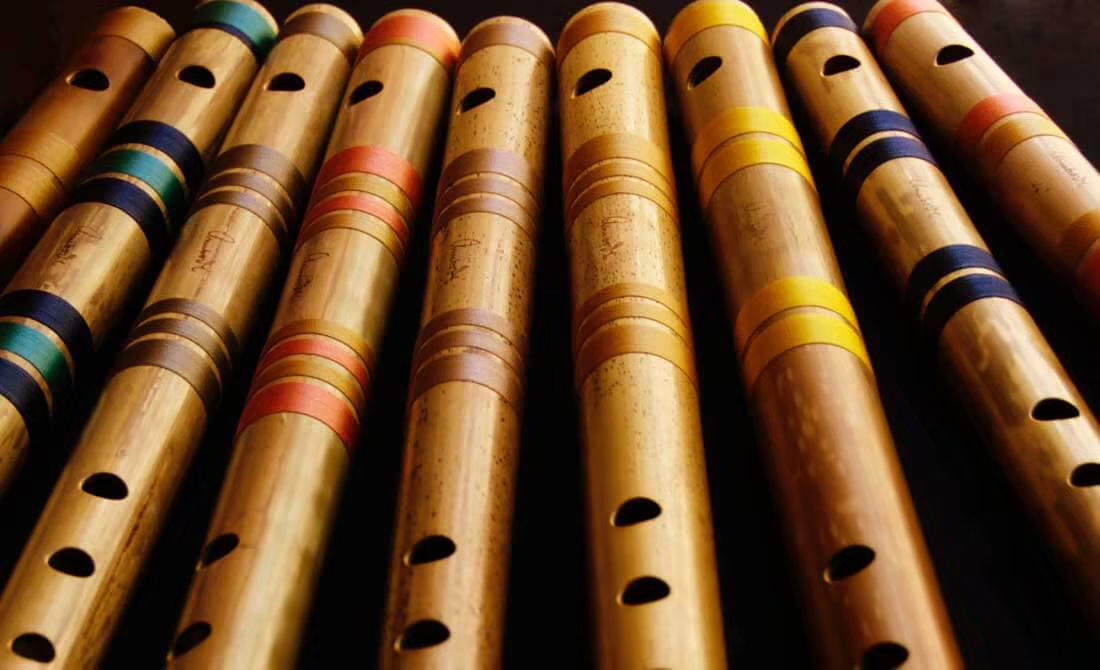
Bansuri naturally invites a slower exhale. Sustained tone requires relaxed support and controlled release — which mirrors, almost exactly, what the best breath regulation protocols are trying to teach. But the flute doesn’t teach it through instruction. It teaches it through necessity. If you want the sound, you have to find the breath. And finding the breath, again and again, becomes a practice.
This is something I discovered gradually, over years of daily playing. I did not begin bansuri as a breath practice. I began it as a musical one. But the two turned out to be inseparable.
Why Breath Is the Foundation
Most wind instrument teaching begins with embouchure — the shape of the lips across the hole — and then moves to finger technique. Breath is often treated as a given, as something the student already knows how to do. This is a mistake, and most serious practitioners eventually circle back to correct it.
The bansuri is less forgiving than most. It has no reed to shape the airstream, no mouthpiece to direct it. There is only the angle of your lips across the embouchure hole, and the quality of the breath moving through them. A breath that is shallow, fast, or driven from the upper chest will produce a thin, airy, or uncentered tone. A breath that comes from low in the body — from the lower ribs and diaphragm — produces a tone with warmth, depth, and carrying power.
The instrument is a biofeedback device. It tells you immediately what your breath is doing. There is no way to fake a good tone, and there is no way to produce one while holding tension in the body. This is both humbling and, eventually, liberating.
The Physiology of a Long Exhale
Contemporary breathwork research has converged on a few reliable findings. One of the most consistent is that an extended exhale — longer than the inhale — activates the parasympathetic branch of the autonomic nervous system. It slows the heart. It lowers cortisol. It increases heart rate variability, the measure of nervous system flexibility and resilience. An exhale that is roughly twice the length of the inhale — a 4-count in, an 8-count out — is now used in clinical settings to address anxiety, insomnia, and trauma-related hypervigilance.
Playing a sustained note on the bansuri is, mechanically, a long and controlled exhale. A single phrase might last eight to twelve seconds. In a session of long-tone practice, a player might spend twenty or thirty minutes cycling through this pattern: a full, relaxed breath in; a slow, steady exhale through the instrument; a brief suspension at the bottom; and then another breath.
The parallels to pranayama — the breath regulation practices of yoga — are not coincidental. Both traditions understood that the exhale is where the nervous system releases. The inhale prepares. The exhale transforms.
What Long-Tone Practice Actually Looks Like
Long-tone practice is exactly what it sounds like: holding a single note for as long as the breath will sustain it, with attention to tone quality, body awareness, and inner stillness.
It is not exciting work. There is nothing to figure out, no phrase to construct, no harmony to navigate. You choose a note — often the fundamental of the flute’s key, the first open-hole note — and you hold it. You listen. You notice what is happening in the body: where tension is held, where the breath is catching, where the tone wavers or thins.
And then you breathe again, and begin again.
The meditation parallels are obvious, and they are real. Long-tone practice trains the same capacity that sitting meditation trains: the ability to stay present with a simple object of attention without being pulled away by thought, planning, anticipation, or judgment. The tone is the anchor. When the mind wanders — and it will — the wavering of the tone brings you back.
Over time, this attention becomes more refined. You begin to notice very subtle things: the slight sharpening of a note when the jaw tightens; the fullness that comes when the breath drops from the chest into the belly; the momentary opening in the sound that happens when you stop trying to make it happen and simply allow the air to move. These are not abstract musical refinements. They are lessons in the relationship between attention, body, and breath.
How Listeners Entrain to the Musical Breath
The effect of this breath-based playing extends beyond the player. When an audience or a group of participants in a sound session is exposed to slow, sustained musical phrasing, something happens that researchers call entrainment: the tendency of biological rhythms to synchronize with external rhythmic patterns.
Cardiac entrainment — the synchronization of heart rate to musical pulse — is well documented. Respiratory entrainment is equally real. Listeners in a sound session will often unconsciously begin to breathe at the rate implied by the musical phrasing. As the melodic phrases lengthen and slow, the room’s collective breath lengthens and slows with it.
This is not suggestibility. It is physiology. The auditory system has direct neural connections to the brainstem regions that regulate breath and heart rhythm. Sound that moves slowly and predictably communicates something to those regions — something that resembles the signal of safety — and the body responds accordingly.
In my own experience facilitating sound journeys, I have watched rooms of thirty or forty people shift their collective breathing within five or ten minutes of the session beginning. The shift is visible: shoulders drop, faces soften, breathing becomes audible and even. It happens without instruction. The music does it.
A Simple Practice to Begin
You do not need a bansuri to access this relationship between breath and sound. Any instrument that requires sustained breath will work — or even the simple act of toning: humming or vowel-singing with as long and even an exhale as you can sustain.
But if you are curious about bansuri specifically, here is where I would suggest beginning:
Find a quiet twenty minutes. Sit comfortably with the flute, and play only one note — whichever note your instrument produces most naturally and fully. Do not try to make it beautiful. Simply try to make it even: a consistent, sustained tone from the first moment of the breath to the last.
Notice what happens in your body as the breath runs out. Many people tighten at the end of the exhale — a subtle grasping, a resistance to the emptiness. See if you can allow the end of the breath to be as relaxed as the beginning. See if you can wait there, at the bottom, for just a moment before inhaling.
Then notice the inhale. Where does the breath go? Is it a chest breath, or does it descend into the belly? Can you allow it to fill you from the bottom up, as if you were filling a vessel?
Do this for twenty minutes. Just this. Come back to it tomorrow, and the day after.
If you practice this way consistently, something will begin to change — not only in your playing, but in how you move through the rest of your day. The nervous system learns from repetition. The body remembers what it has practiced. And a body that has spent twenty minutes each morning in slow, deliberate, extended breath begins to carry that rhythm with it into everything else.
The Deeper Teaching
I have been asked many times whether meditation makes you a better musician. I think the question is backwards. The question is whether music — played with real attention, in relationship with the breath — can become a meditation.
The answer, I have found, is yes. And the bansuri, perhaps more than any other instrument I know, makes that path obvious. It does not let you hide behind technique. It does not let you use speed or volume to conceal what is actually happening in your body. It asks, every time you play it, for the same thing: presence, softness, and a breath that comes from somewhere deep enough to be true.
That is the practice. And it is one that never ends.