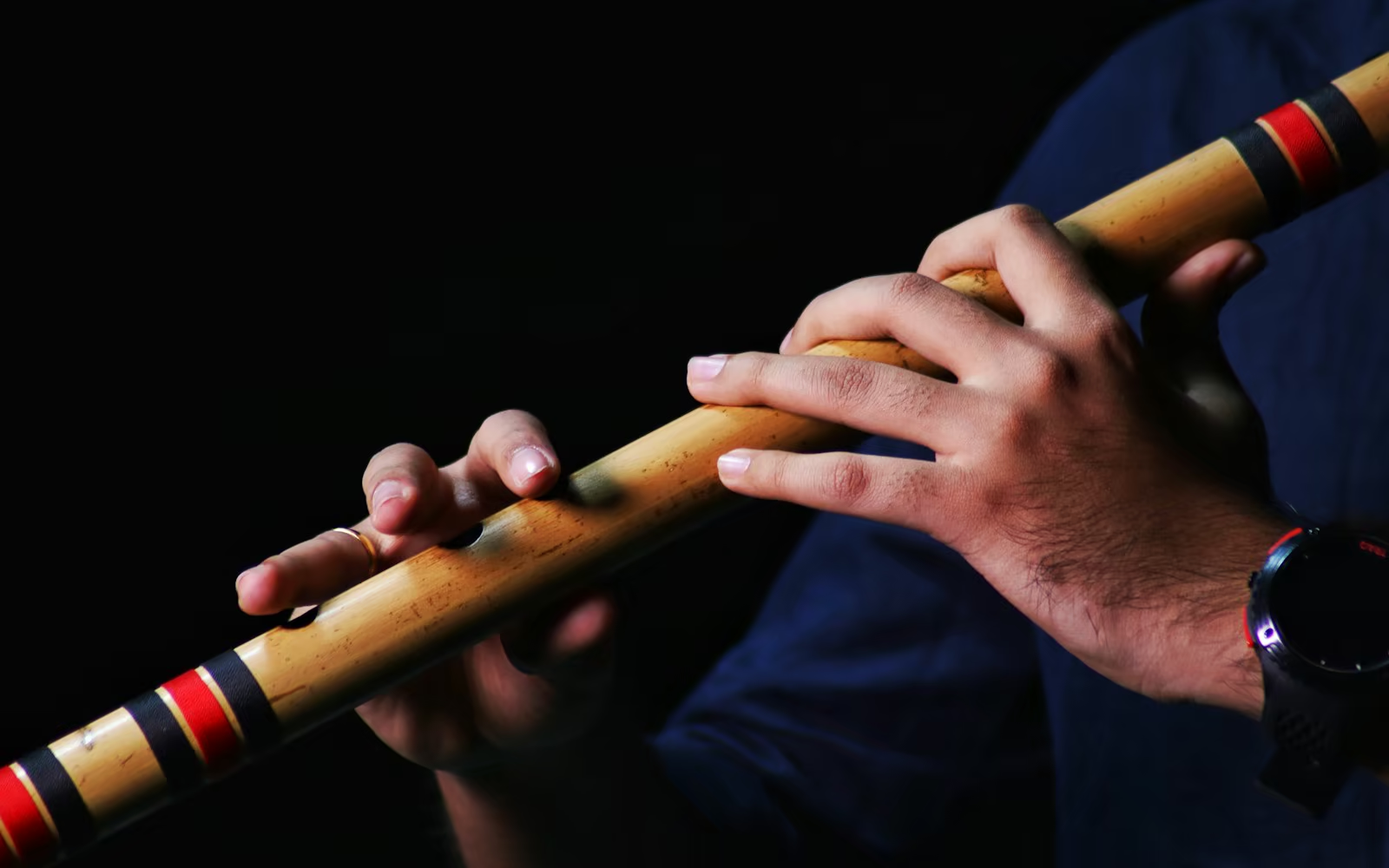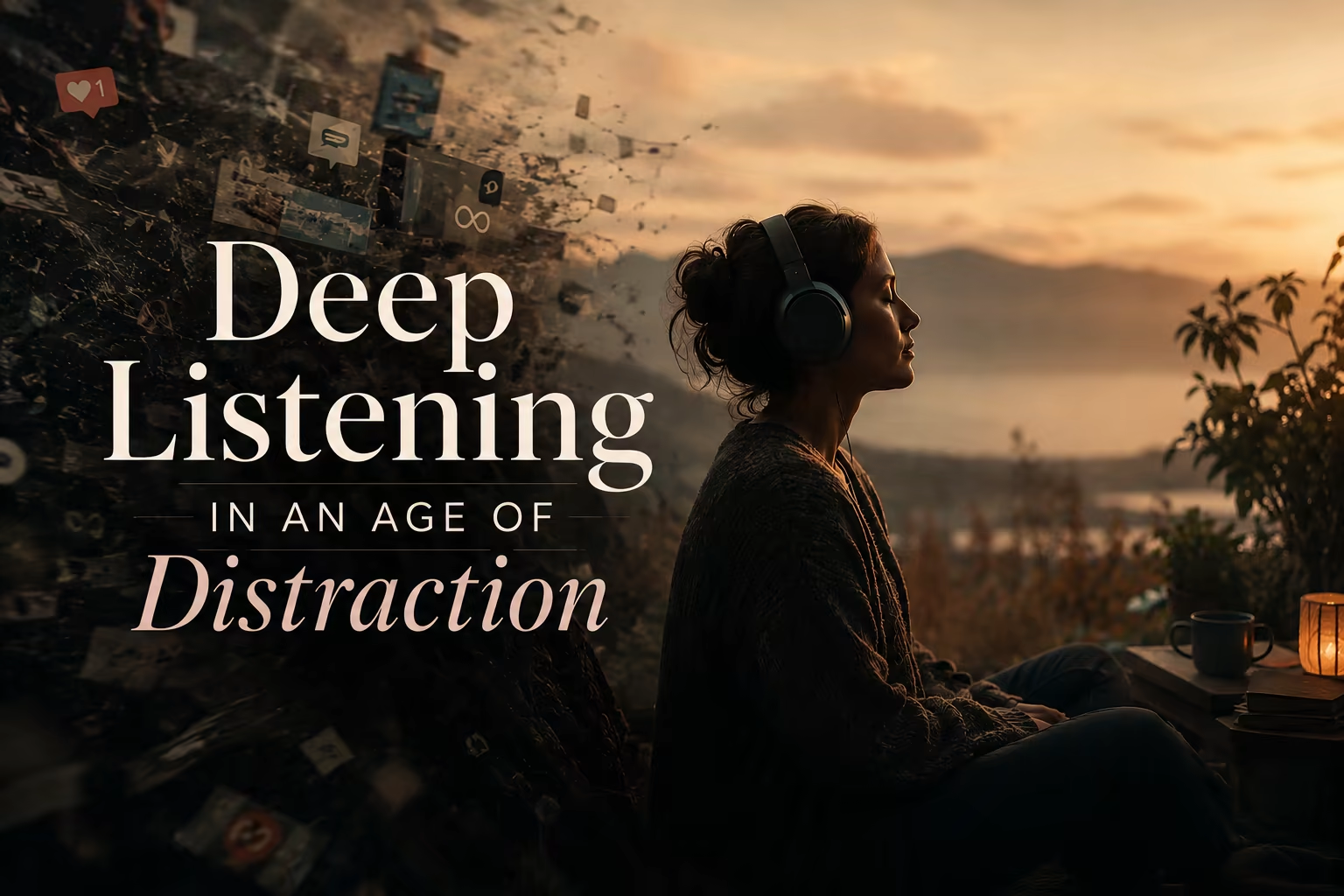
There is a moment in a long raga performance — sometimes it comes forty minutes in, sometimes an hour — when something shifts. The melodic phrases, which have been slowly accumulating, begin to feel inevitable. The listener who has stayed with it finds themselves inside the music in a way that simply cannot be rushed. The raga has done what it was designed to do: it has taken someone from the surface of ordinary consciousness and walked them, gradually and patiently, somewhere deeper.
This kind of experience is becoming rare. Not because the music has changed, but because we have.
The Shrinking Window
Attention spans are not merely a cultural talking point. They are measurable, and the measurements are concerning. Researchers studying behavioral patterns in digital media consumption have documented a consistent contraction in the average time a user engages with any single piece of content before moving on. Where a listener in the early era of streaming might follow a track all the way through, engagement data now shows significant drop-off in the first thirty seconds. Platform design has adapted accordingly — and in adapting, has accelerated the problem.
Spotify’s algorithm weights early listener retention heavily in how it promotes tracks. Songs that hold attention in their opening moments surface to more people. Songs that develop slowly, that take their time, that ask something of the listener before they deliver, are quietly buried. The consequence, playing out across millions of artists’ decisions about how to structure their music, is that patience is no longer commercially viable. The hook must come immediately, or it will not come at all.
YouTube has followed the same logic, optimizing relentlessly for watch time and click-through rate, surfacing short-form content through its Shorts feature with the same reward structure that made TikTok so effective at eroding sustained attention. The algorithm does not intend any harm. It simply does what it is designed to do — maximize engagement — and it has learned, with extraordinary precision, that brevity, novelty, and surprise are the most reliable levers for keeping a human eye on a screen.
The cumulative effect of years spent in this environment is neurological. The brain is a plastic organ. It rewires itself around the demands placed on it. A mind that has been trained, hour after hour, day after day, to expect a reward within the first thirty seconds will find sustained attention increasingly uncomfortable. The capacity for deep focus, like any muscle, atrophies when it is not used.
What Indian Classical Music Is Actually Asking
Raga is one of the oldest living musical traditions on the planet. Its structural logic is entirely opposed to what the algorithm rewards.
A full raga performance unfolds in movements. The alap — the slow, unaccompanied opening — can last anywhere from ten minutes to an hour. It has no fixed rhythm, no percussion, no dramatic arrival. It is pure melodic exploration: the musician moving through the notes of the raga the way a sculptor moves around a block of stone, feeling its contours, revealing its character from different angles. Nothing is rushed. The raga has its own inner logic, and that logic cannot be compressed without being destroyed.
This is not a design flaw. It is the point.
The tradition understood, long before neuroscience had the vocabulary to describe it, that the depth of an experience is proportional to the time spent entering it. A raga does not deliver its emotional or spiritual content quickly because it cannot. The later movements — the gradual introduction of rhythm, the building of momentum in the drut — land with tremendous force precisely because of everything that has come before. Forty minutes of alap is not preamble. It is the foundation without which the conclusion has no weight.
This is an entirely different relationship between artist and audience than the one that streaming has normalized. It asks the listener to bring patience, trust, and sustained attention. It asks them to tolerate not knowing where they are going. It asks them to stay.
The Neuroscience of Going Slow
There is a growing body of research on what happens in the brain during sustained, focused listening — particularly listening to music that is harmonically and rhythmically predictable, unfolding at a slow pace.
Under these conditions, the default mode network — the brain’s resting-state circuitry, associated with mind-wandering, self-referential thought, and the mental noise of unfinished business — tends to quiet. The anterior cingulate cortex, which plays a central role in attention regulation, shows increased coherence. The listener becomes more present, not because they are trying to be, but because the music has created conditions in which presence is the natural response.
This is sometimes described as a flow state or as a meditative state, but it is worth being precise about what is happening physiologically. The nervous system is not merely relaxed. It is engaged in a particular quality of attentiveness — wide, soft, non-reactive — that is in almost every respect the opposite of what digital overstimulation produces. Where algorithmic content keeps the brain in a state of continuous low-level alertness and reward-seeking, slow music produces what researchers have begun calling “attentive rest”: a state of calm wakefulness in which the brain is present but not activated, aware but not scanning for threat.
This state is associated with high heart rate variability, coherent brainwave activity in the alpha and theta ranges, and measurable reduction in cortisol. It is also associated with the kind of insight, emotional processing, and creative integration that the busy, stimulated mind cannot access.
Attention as Practice
There is something worth naming directly: the discomfort that arises in the first minutes of trying to listen deeply to long-form music after a period of heavy algorithm use is not a signal that the music is boring. It is the feeling of withdrawal.
The brain that has been conditioned to expect rapid novelty will generate restlessness, impatience, and the urge to check a phone when those rewards are withheld. This is not a character flaw. It is a trained response, and like all trained responses, it can be retrained. But only through practice — through the repeated, deliberate choice to stay with something long enough that the deeper layer of experience becomes accessible.
Indian classical musicians speak of this in terms of seva — service, devotion, the long preparation. A student of raga will spend years learning to listen before they are considered ready to perform. The tradition does not assume that the capacity for deep listening is innate. It treats it as a skill that must be cultivated, slowly and patiently, through sustained practice.
This is exactly what the modern media environment does not offer. And it is exactly what we most need.
Returning to the Long Form
Listening to a full raga is, among other things, a rehearsal for a different way of being in time. It reacquaints the nervous system with the sensation of waiting without anxiety — of moving through an unfolding without knowing the destination, and finding that the not-knowing is not dangerous. This is a skill with applications far beyond music.
The same quality of attention that allows a listener to stay with an alap for forty minutes is the quality of attention that allows a difficult conversation to be heard fully, a complex problem to be sat with rather than solved prematurely, a moment of beauty to be actually experienced rather than photographed and scrolled past.
We are not short of information. We are short of the capacity to be with anything long enough for it to matter.
The antidote to this, surprisingly, is not more discipline, more productivity, or more optimization. It is music that takes its time. Music that does not apologize for its length or soften its demands on the listener. Music that trusts that if you stay with it, something real will eventually happen — and that the waiting is part of what makes it real.
That is what the ragas have always known. We are only now beginning to remember.