Many people come to music therapy because they feel overloaded: mentally busy, emotionally stretched, physically tense. The body is often still carrying stress long after the mind decides to relax. Sound helps bridge that gap — not through distraction, but through something more fundamental. It speaks directly to the parts of us that words cannot reach.
The Nervous System Is Always Listening
Before we can understand how sound heals, we need to understand what we are healing. The autonomic nervous system operates beneath conscious awareness, quietly regulating heart rate, digestion, breath, immune function, and the subtle tension held throughout the body. It has two primary modes: the sympathetic state — often called “fight or flight” — and the parasympathetic state, sometimes described as “rest and digest.”
In our modern environment, most of us spend far too much time tilted toward the sympathetic. Chronic noise, information overload, unprocessed emotion, and the relentless pace of daily life keep the nervous system on a low-grade alert. Over time, this becomes the baseline — and we forget what it feels like to be truly at rest.
Sound can interrupt that pattern. Not by forcing relaxation, but by offering the nervous system something it can use: predictability, resonance, and a sustained invitation to soften.
How Resonance Speaks to the Body
Sound is vibration. And the human body — made of fluid, tissue, and bone — is a resonant structure. When you hear a low sustained tone, you do not only perceive it with your ears. You feel it in your chest, your belly, your jaw. The body becomes a kind of instrument that the sound is playing.
Low-frequency tones — below 200 Hz — have been shown in research to encourage a physiological settling response. The breath naturally slows. Heart rate begins to follow. The muscles around the jaw, shoulders, and hips — three of the body’s primary tension storage sites — begin to release their holding.
This is not a placebo effect, and it is not simply about pleasant music. It is a physiological response to vibration. Sustained tones give the nervous system something to entrain to — a steady rhythm that it can synchronize with, the way ocean waves gradually slow a racing mind when you sit beside the sea.
The Vagus Nerve: Sound’s Most Important Pathway
The vagus nerve is the body’s longest cranial nerve, running from the brainstem down through the throat, heart, lungs, and digestive system. It is the primary channel of the parasympathetic nervous system, and its activation is closely associated with feelings of safety, connection, and calm.
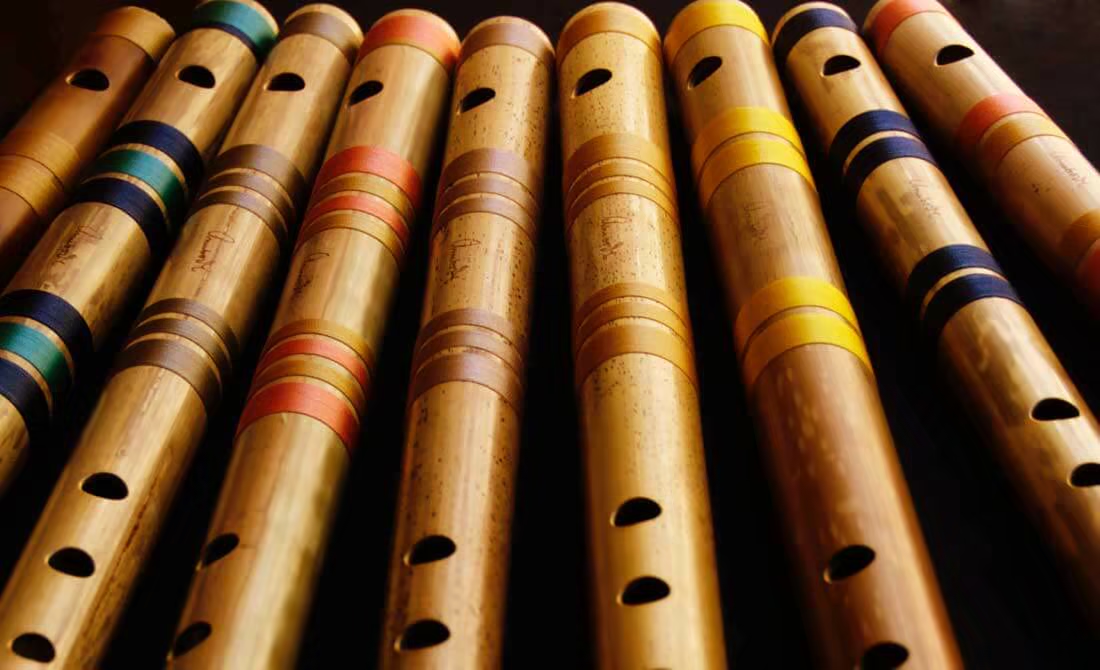
What many people don’t know is that the vagus nerve is directly linked to the muscles of the inner ear, the larynx, and the throat. Sound — especially vocal toning, overtone chanting, and certain wind instruments like the bansuri flute — directly stimulates vagal tone through vibration in these tissues. Each breath pushed through the flute, each resonant sustained note, sends a signal down the vagus nerve: it is safe. You can soften now.
This is part of why live sound experiences feel different from recorded music. The three-dimensional nature of sound in a room — the way it wraps around the body, reflects off surfaces, enters from all directions — creates a more complete vagal stimulation than earbuds can provide. The entire nervous system is bathed in the sound, not just the auditory cortex.
Breath Entrainment and the Rhythm of Safety
One of the most measurable effects of music therapy is its influence on breath. When we are stressed, our breathing tends to be shallow, fast, and thoracic — high in the chest. When we are safe and relaxed, breath drops into the belly and slows naturally.
Sustained musical tones, particularly those played at a slow melodic pace, tend to entrain the listener’s breath to the rhythm of the phrase. Listeners begin unconsciously matching their inhalation to the rise of a melody and their exhalation to its fall. Over the course of a session, this gentle entrainment can shift the breath rate from fifteen or twenty cycles per minute down to six or eight — a range associated with heightened heart rate variability (HRV) and deep parasympathetic activation.
HRV — the natural variation in the time between heartbeats — is one of the most reliable markers of nervous system health. Higher HRV is associated with resilience, emotional regulation, and a strong immune response. Lower HRV is associated with chronic stress and increased disease risk. Practices that deepen breath and slow the heart rhythm, including sound meditation, have been shown to measurably improve HRV over time.
Repetition, Predictability, and the Signal of Safety
Peter Levine, the developer of Somatic Experiencing, writes that trauma is not what happened to you — it is what happened inside you in response to what happened. The nervous system, in moments of overwhelm, can become frozen in a state of incomplete response: neither fully sympathetically activated nor fully parasympathetically at rest, but stuck somewhere in between.
One of the key conditions for completing this cycle and returning the nervous system to equilibrium is safety. And safety, on a physiological level, is deeply connected to predictability.
This is why sound bath sessions are structured the way they are. The consistent drone of a tanpura or shruti box. The recurring melodic phrases of the bansuri. The steady shimmer of crystal singing bowls. Repetition tells the nervous system: this is not a threat. Nothing is coming. You do not need to scan the horizon. When the environment becomes predictable, the vigilance response can ease, and the body finds its way back to itself.
The Transition Into Silence
Silence is not the absence of the session — it is the destination of it. Some of the most potent moments in a sound journey happen in the stillness that follows sustained sound.
When the last tone fades and true quiet settles over a room, something remarkable happens. Listeners often report a sudden deepening of body awareness, a sensation of spaciousness or lightness, a feeling of being very present and very still at the same time. This is not imagination. What is happening physiologically is that the nervous system, having ridden the wave of sound down into a more settled state, is now integrating that shift. The brain is recalibrating. The body is absorbing the change.
This integration window — the silence at the end of a session — is protected time. It is why the best sound journeys do not end abruptly. The closing of a session is itself a composition: the gradual thinning of sound, the widening of space between notes, and the unhurried arrival of stillness.
Why It Is Different Every Time
One final thing worth understanding: sound medicine is not a formula. The nervous system is not a machine to be calibrated. Each person enters a session carrying a unique accumulation of history, tension, and readiness. Each session unfolds differently depending on the room, the instruments, the energy of those gathered, and the subtle intuitions of the practitioner.
Some sessions bring tears — an old grief that finally finds its moment to move. Some bring laughter, or visions, or simply a very deep and dreamless sleep. Some bring nothing dramatic at all — only a quiet, lasting sense that something has shifted.
That unpredictability is not a flaw. It is the nature of working with a living system. Sound does not impose healing. It creates conditions in which healing becomes possible. What the body and nervous system do with those conditions is always, beautifully, their own.